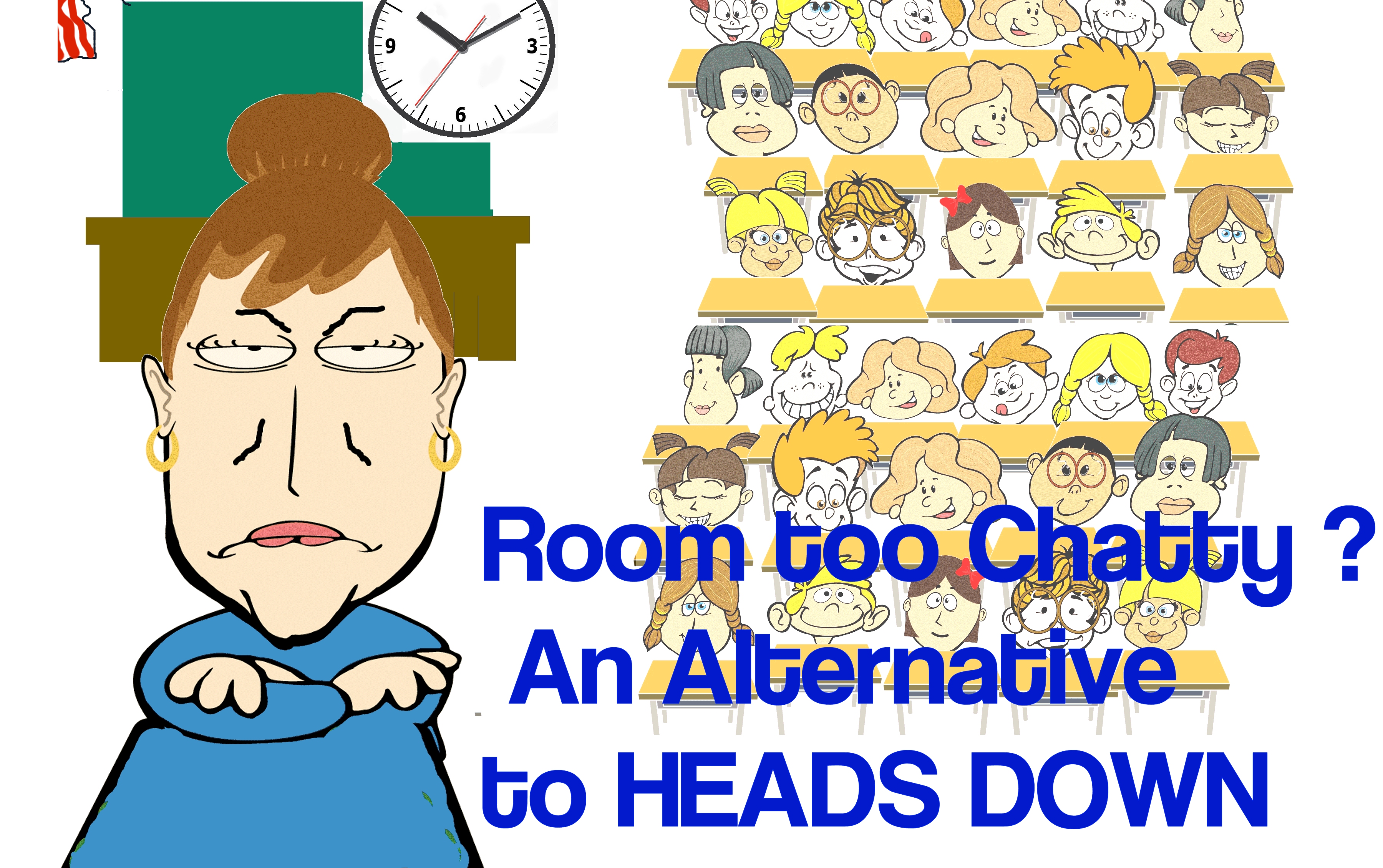
We’ve All Been There…. the students will not stop talking.
Or the silence only lasts as long as you hollering at them.
So you do what your teacher did to you, you raise your voice one last time and say, “Okay, everyone heads down!”
Then you have to police who is actually putting their head down since it’s not comfortable, and you feel bad for the half the class that was actually being pretty good. You snap, “head down.” to the ones who are being squirmy and you feel uncomfortably close to the kind of teacher you really don’t want to be.
Sometimes I want students to be able to talk, and to be able to ask each other questions (because sometimes you can’t get to them, especially when instructing a small group), and to trust them to be able to actually work and talk a bit. Sitting all day in a plastic chair can be boring. When students are happy, they do better work and don’t cause as many discipline problems. It’s nice when the students get into a ‘flow’ state and don’t want to talk but that’s fairly rare. It’s difficult to consistently provide compelling seat work.
This was a trick I ‘discovered’ last year – I’m not going to claim it’s original or innovative. It’s just never been suggested to me. It’s so simple and obvious that I almost feel bad talking about it, because invariably someone is going to arrive here and think, ‘Oh, just that. I already do that.’ But, nothing is obvious until after you figure it out. So mention it on the off chance it hasn’t occurred to you, dear reader. We teachers have too much going on in our minds already! In fact, it would be fun to make even a partial list of what goes on in our brains during a typical lesson including which assembly of questionable academic value has been scheduled during direct instruction time. But, I digress. Here’s the system I use.
First warn the students ahead of time that talking in whispers is a privilege and that many teachers do not allow even that to remind them how nice you are. (Since you are!) “If the teacher can hear it, then that’s too loud,” is the standard. You can demonstrate how to whisper. When their talking finally does get out of hand, when they are practically shouting over one another, use your best Love & Logic ® empathy, and tell them that, ‘Sorry, but they need to be reminded of what silence sounds like.’ Also that you need to prove to them that they can be silent. It won’t kill them.
Have them sit up straight and fold their hands on their desks. Tell them they can’t work, can’t read, and that the timer will be reset if anyone talks, works, or reads, even a little. Set a timer for two minutes, preferably one that the entire class can see so that the seconds will drag by excruciatingly slowly. Then just be sure they sit there without working. Occasionally you will have to reset the clock and drag it out to four minutes, when some child talks with just a few seconds left.
I do tell them, ‘This is supposed to be boring, to remind you that working quietly is not such a bad option.’ But don’t lecture them for a few reasons: One, it’s entertaining to them and makes the time go too quickly. Second, when you lecture then it feels more like you’re just punishing, instead of practicing quiet. It’s a dead give away that you’re totally pissed off. Even though part of it is a punishment, no question, it seems less so if you’re just silent. It also makes you seem more strict in a good way. Besides, they tune out nagging after two sentences. Yada..yada…yada…they’ve heard it all before. It hurts your credibility. Also, the students hear the beauty of the silence, the peace on their ears. This is one reason it’s so effective, most can feel the peacefulness and they like it! It gives them an internal reason to be quieter other than purely out of fear.
This is an consequence to threaten and use after they’ve wasted excessive time lining up. Just start looking at your watch and calling out (since most 2n graders don’t pay rapt attention) the amount of time they will now be ‘paying back.’ “You waste my time, and it’s only fair that I waste yours.” is what I tend to say. Second graders love the idea of fairness.
This works for several reasons. One, children who are naturally used to being quiet, don’t find it so hard, they almost like it. It’s only hard on the ones that need the self discipline. They are learning a valuable lesson in self control. So this time is not wasted. It’s easier to see who is complying and who is not because sitting up is more natural a position than putting a head down on the desk. It doesn’t feel quite so punitive. Third, when you do finally let them work they can move seamlessly
into that state. Sometimes if it’s necessary during to do this during silent reading you can ignore those actually reading and then the entire class slips back into the behavior that you wanted all along without such an abrupt end.
You will probably need to reset the clock back to two minutes once or twice if you have an impulsive kid or two. (If that child hasn’t learned after a second time, just separate them, don’t punish the entire class. Again, some are just too young to feel peer pressure especially the boys.) You may have noticed that the sting of peer pressure doesn’t work perfectly well in 2nd grade because many of them are still rather immature and focused on themselves and just don’t care what others think. (When it suits them.) But it’s a start, they do need to become aware of it, since socialization is half of what school is all about.
The best part, you get the peace and quiet which sometimes you really just need. You know, those times when you can practically feel the cortisol pumping into your blood stream and your nerves feel like bare wires without a shred of insulation left. But you don’t have to be the slightest bit mean or angry about it.
You will have to watch them for it to be effective. After you follow through on this a few times the
threat of this punishment will start to work. If your class is filled with super energetic kids as mine was just recently you’ll need to do this once or twice each hour. If nothing you will enjoy the peace & quiet and revel a bit of fair play because those stu
dents who so blatantly ignored you deserve a consequence. It sure beats yelling.
It’s easy to forget that the students, even the chatty ones, want a quiet room as much as you do. Also, students love those teachers who can control them and be strict but without getting all angry and huffy about it.
The forced silence really does drive home the message. The students soon recognize they want that peace and quiet just as desperately as you do, even if they have trouble staying that way.
- Scott

 Straight Talk on 2nd Grade